

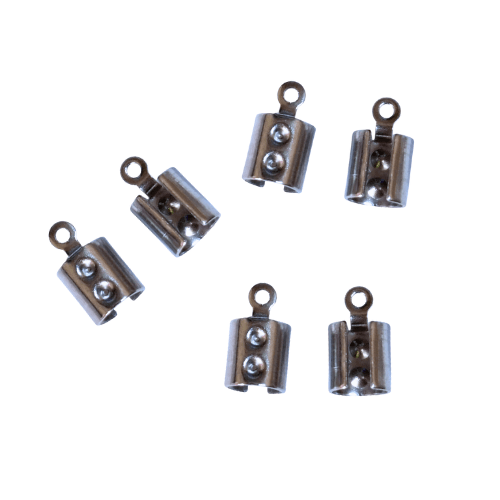
Description
These are those tiny stainless steel tube-shaped findings that act as the “locks” holding everything together at the ends of necklaces or bracelets.
How Tube String End Crimps Are Commonly Used
1. Attaching a Clasp
This is the most common use.
-
Thread your beading wire through the crimp tube.
-
Add the clasp or a jump ring.
-
Loop the wire back through the crimp tube.
-
Use crimping pliers (or flat pliers if you don’t have them) to squeeze the tube.
-
Trim off the excess tail.
Result: The clasp is securely fastened to the wire without knots.
2. Securing Multi-Strand Jewelry
If your design has two or more wires, each strand is usually finished with its own crimp tube before gathering them into a multi-strand clasp.
This keeps all the strands neatly anchored and prevents them from slipping.
3. Floating / Illusion Necklaces
Crimp tubes are placed between beads along transparent beading wire (or fine tiger tail) to hold beads in place, giving the illusion they’re “floating.”
Here, the crimps aren’t hidden — they’re part of the design.
4. Stopping Beads From Sliding
Sometimes designers place a crimp inside the bead sequence to stop beads from moving around too much.
This is common in charm bracelets or spaced-out bead designs.
5. Making Loops for Charms or Dangles
You can use a crimp tube to secure a small loop at the end of a wire and attach a charm or pendant.
This works like attaching a clasp but instead of a clasp, you add a decorative piece.
Why Stainless Steel Tubes Are Preferred
-
Durability – Stainless steel crimps won’t wear out or tarnish with time.
-
Strength – They hold tightly even on slick nylon-coated wire.
-
Professional look – When crimped with the correct pliers, they fold neatly and blend into the design.
In short:
Tube string end crimps are most commonly used to finish off the ends of beaded jewelry by securing clasps, holding beads in place, or creating loops — making them one of the most essential little findings in jewelry making.


Reviews
There are no reviews yet.