
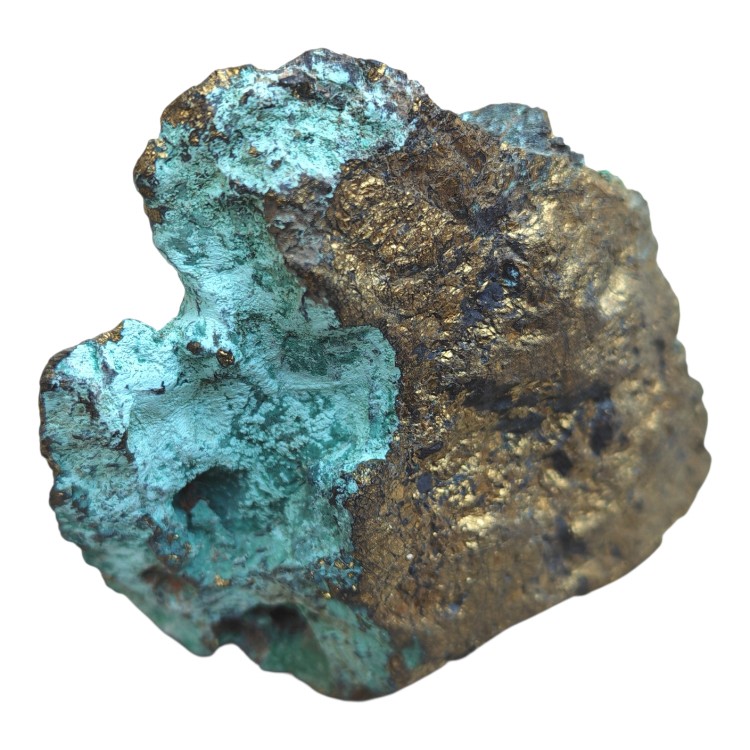
Description
The specimen is primarily chalcopyrite (a copper-iron sulfide) rather than pure pyrite, and the sky-blue/turquoise coating is a secondary copper mineral, most likely chrysocolla.
-
Why it looks like pyrite: Chalcopyrite (CuFeS2) is closely related to pyrite (FeS2) and shares a similar brassy-yellow metallic luster (often called “peacock ore” when tarnished or simply copper pyrite).
-
Why it has the blue crust: Pure pyrite contains only iron and sulfur, which oxidizes into rusty brown/yellow iron oxides (limonite/goethite). Because chalcopyrite contains copper, exposure to weathering, moisture, and silica-rich groundwater causes the copper to oxidize into vibrant secondary copper minerals.
-
The blue mineral identification:
-
Chrysocolla (most probable): A hydrous copper silicate that forms soft, matte, light cyan-to-turquoise encrustations or botryoidal coatings directly on altering copper ore.
-
Aurichalcite / Planèrite: Other secondary copper minerals common in Namibian copper deposits (such as the Otavi Mountainland / Tsumeb / Kombat regions) that form pale blue to turquoise crusts.
-
If the metallic section leaves a greenish-black streak on unglazed porcelain (or scratches more easily than a steel blade, Mohs 3.5–4), it confirms chalcopyrite over iron pyrite (Mohs 6–6.5).


Reviews
There are no reviews yet.