
Description
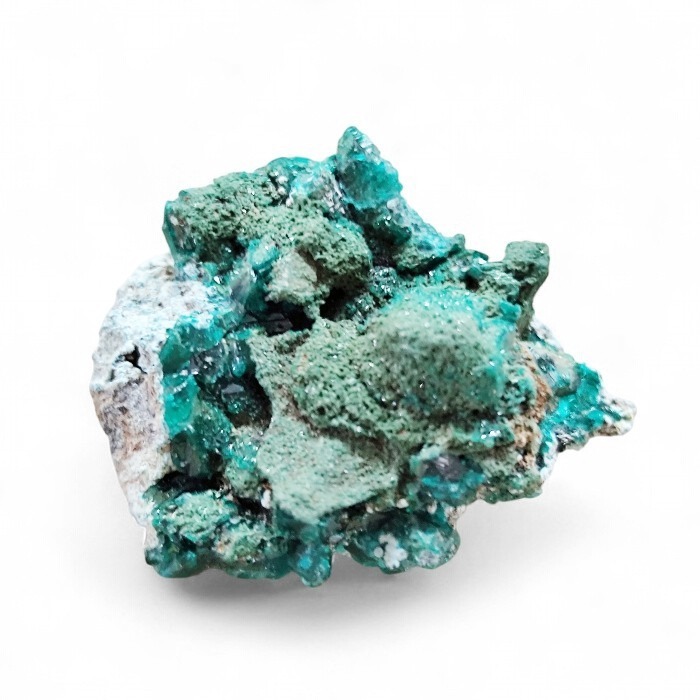
This 33mm specimen is fascinating because of the distinct pseudomorphic or coating relationship between the two minerals. You are spot on—it certainly looks like a secondary copper mineral is interacting with the dioptase.
Is it Malachite?
It is highly likely that the pale, velvety green coating is Malachite. In DRC localities, it is very common for Malachite to form as a secondary growth over Dioptase, sometimes eventually replacing it entirely (a pseudomorph).
However, there are a few other possibilities common to the Congo:
-
Planchéite: This often forms as a light teal-to-fibrous blue-green coating. If the “dusty” parts look slightly more blue than a standard forest-green malachite, it could be Planchéite.
-
Chrysocolla: This can form as a matte, light-colored druse or botryoidal coating over Dioptase, though it usually has a more “sky blue” tint.
-
Conichalcite: Occasionally found in these environments, it presents as a bright, lime-green “pistachio” colored crust.
Dioptase with Malachite Coating – 33 mm
Locality: Republic of the Congo (DRC)
Dimensions: 33 mm x 28 mm
Mineralogical Profile
This specimen is a “two-generation” copper silicate/carbonate piece, perfect for collectors who enjoy mineral associations and pseudomorphs.
-
Primary Mineral: Deep, “electric” emerald-green Dioptase crystals with sharp rhombohedral faces and a high vitreous luster. These crystals are visible in the “windows” or cavities where the secondary coating has not reached.
-
Secondary Coating: A pale, mint-green Malachite (likely fibrous or “velvet” habit) that has partially draped over the dioptase. This creates a striking “frosted” look, highlighting the relief of the specimen.
-
Texture: The contrast between the glassy, sharp Dioptase and the matte, velvety secondary coating provides a wonderful tactile and visual complexity.
-
Matrix: A light-colored silicified host rock is visible on the base and left flank, providing a neutral backdrop for the vibrant greens.
Collector’s Note
Specimens that show the transition between minerals are highly sought after for educational displays. It perfectly illustrates the chemical evolution of a copper deposit—where the silicate (Dioptase) begins to interact with carbonated waters to form the carbonate (Malachite).
Technical Summary
-
Minerals: Dioptase ($CuSiO_{2}(OH)_{2}$) and likely Malachite ($Cu_{2}CO_{3}(OH)_{2}$)
-
Hardness: 3.5 to 5 (Mohs Scale)
-
Crystal System: Trigonal (Dioptase) / Monoclinic (Malachite)
-
Condition: Completely natural, showing an authentic secondary mineral growth.


Reviews
There are no reviews yet.